Financial abuse can leave you with no real control over your money, even when you have an income of your own.
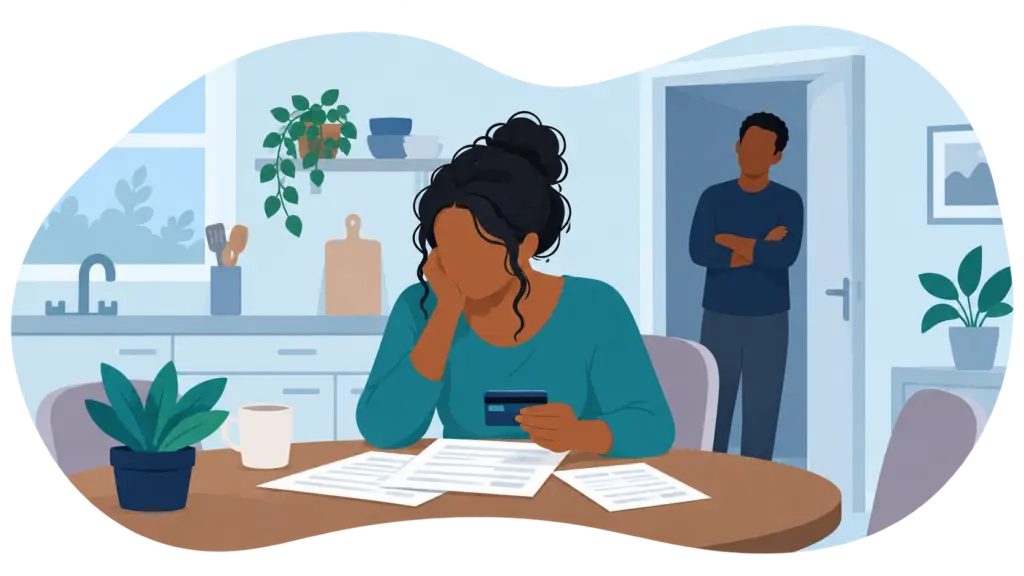
Your wages have reached the account, but you still feel that you have to ask before buying something.
You know there is money available, yet putting petrol in the car, meeting a friend for lunch or replacing something you need could lead to questions or an argument.
Perhaps you have started hiding small purchases. Maybe your card has been declined because a limit was changed without telling you. You might know very little about the household finances, despite being responsible for the consequences when bills are not paid.
When money is used to restrict your choices or make you dependent on someone, it may be financial abuse.
When does managing money become control?
Couples manage money in different ways. One person may handle most of the bills because they have more time or feel more confident doing it.
This can be a healthy arrangement when both people agree, have access to financial information and can question decisions without being frightened.
Financial control is different.
One person may know what comes in, what goes out and how every account works. The other is allowed very little information or choice. They may be made to feel irresponsible, even when they have never been given a fair opportunity to manage their own money.
A useful question to ask is:
Can I make reasonable decisions about money without feeling frightened of their reaction?
If the answer is no, something may be wrong.
Although financial abuse can also happen between family members, this article focuses mainly on partners and former partners.
Signs of financial abuse
Financial control is not always obvious. It can involve stopping someone from accessing money, but it can also involve exploiting their income, damaging their financial position or preventing them from earning.
Signs can include:
- Making you hand over wages, benefits or other income.
- Preventing you from accessing bank accounts or online banking.
- Giving you an allowance while spending freely themselves.
- Checking receipts or demanding an explanation for every purchase.
- Making you ask for money for food, travel, clothing or medication.
- Using your card or account without permission.
- Taking out credit or creating debt in your name.
- Pressuring you to sign a loan, act as a guarantor or transfer an asset.
- Stopping you from working, studying or attending training.
- Interfering with shifts, childcare or transport so that keeping a job becomes difficult.
- Hiding bills, income or debts from you.
- Withholding important documents such as a passport, bank statement or benefit letter.
- Threatening to take away your home, car, phone or access to essential services.
Not everyone will experience all of these behaviours. What matters is how the person is using money or resources and the effect this has on your independence.
You might earn your own income and still have no control over it. You may live in a household that appears comfortable while regularly going without things you need.
Some people find themselves standing at a checkout unsure whether their card will work. Others avoid opening letters because they are frightened of finding another debt they did not create.
These moments can bring embarrassment and shame, but the situation is not a sign that you are bad with money.
It may begin as an offer to help
Financial abuse often develops gradually.
A partner may offer to manage the bills because you are busy. They might suggest using one account because it will be easier or ask you to stop working because they can support you.
At first, the arrangement may feel practical. Over time, you are given less information. Passwords are changed. Your questions cause arguments. Money becomes something they control and you have to request.
This slow change can make the behaviour difficult to recognise. You may think you agreed to the arrangement, so you have no right to challenge it.
Agreeing that one person will manage the finances does not mean agreeing to be excluded from decisions, denied access to money or placed in debt.
Financial abuse and economic abuse
Financial abuse usually refers to control involving money, accounts, credit, debt and income.
The law uses the wider term economic abuse. This also covers someone’s ability to access or keep property and obtain essentials such as food, clothing, housing, heating, transport and other services.
Economic abuse is recognised as a form of domestic abuse under the Domestic Abuse Act 2021.
You do not need to work out whether your experience meets the legal definition before speaking to someone. If another person’s behaviour is harming your financial security or leaving you without real choices, support is available.
Financial control after separation
Ending a relationship does not always end the financial pressure.
An ex-partner may empty a joint account, stop paying their share of the mortgage or repeatedly delay the sale of shared property. They might continue using your personal details or refuse to return financial documents.
Money intended for children can also be used to maintain contact or apply pressure. Payments may be withheld whenever you set a boundary or offered only if you agree to something in return.
A missed payment or ordinary financial disagreement is not automatically abuse. The concern is when money is deliberately used to punish, frighten or continue controlling you.
The effects can remain after the behaviour stops. Debt, damaged credit and housing problems may take time to resolve, but specialist financial and domestic abuse support can help you understand your options.
Getting help safely
Sudden changes to passwords, accounts or joint finances may alert the person controlling you. Think about how they are likely to respond before making changes.
If possible, use a phone or computer they cannot access when looking for support. This could be a trusted person’s device or a computer at work or in a library.
If it is safe, keep copies of important documents somewhere the other person cannot reach. These could include bank statements, identification, benefit information, mortgage or tenancy documents and details of debts.
You can also ask your bank whether it has a specialist team for customers experiencing financial abuse. Before closing or changing a joint account, get independent advice about how this could affect you.
MoneyHelper’s financial abuse guidance provides further information about accounts, debts, important documents and specialist financial support.
You do not have to confront the person or explain what you are planning.
If you or someone else is in immediate danger, call 999.
Talk to Freeva
Freeva supports people affected by domestic abuse across Leicester, Leicestershire and Rutland.
Our advisers can listen to what has been happening, help you consider your options and support you with safety planning. You can contact us even if you are unsure whether the behaviour counts as abuse.
You do not have to clear the debt, recover every document or understand every account before asking for help. You can start by telling someone what is happening.
Call the Freeva Helpline
Monday to Friday: 8am to 8pm
Weekends and Bank Holidays: 10am to 4pm
You can also text 07715 994 962.
Calls are free from mobiles, landlines and payphones and will not appear on your telephone bill.
Outside these hours, call the 24-hour National Domestic Abuse Helpline on 0808 2000 247.
If you think someone may be checking your device, read Freeva’s guidance on hiding your browsing history.